Research Impact at Ohio State
Highlighting discovery, innovation and collaboration

Ohio State researchers develop vaccine platform targeting deadly swine coronavirus

A new vaccine technology developed at The Ohio State University could offer swine producers a safer, more effective way to prevent porcine epidemic diarrhea virus (PEDv), a highly contagious coronavirus that can be fatal to more than half of infected newborn piglets. 

The live attenuated vaccine candidate was created in the laboratory of Qiuhong Wang, PhD, professor in Ohio State’s Department of Animal Sciences and the Center for Food and Animal Health and is now being commercialized through a newly formed company, Innovative Viral Solutions. 

PEDv moves quickly through barns and is especially devastating for newborn piglets, which can become infected and die within days of birth. 

“This virus is very, very deadly for neonatal pigs,” Wang said. “Within one week after they are born, they can be infected and die. There is no time to immunize the piglets themselves.” 

Qiuhong Wang, PhD, professor in Ohio State’s Department of Animal Sciences and the Center for Food and Animal Health headshot
Qiuhong Wang, PhD, professor in Ohio State’s Department of Animal Sciences and the Center for Food and Animal Health

 Because piglets cannot be vaccinated early enough, effective protection depends on immunity passed from the sow through her milk. However, many existing PEDv vaccines are delivered by intramuscular injection and primarily stimulate antibodies in the bloodstream rather than at mucosal surfaces, where PEDv infects. 

“When you give an intramuscular vaccination, it mainly induces antibodies in the blood,” Wang said. “Those antibodies do not efficiently go to the gut or the mammary gland, so piglets are not protected very well.” 

In the absence of better options, farms often rely on a practice known as feedback, in which intestinal material from infected piglets is fed to sows to intentionally expose them to the live virus. 

“Whenever they have an outbreak, they take the dead pig intestines, make a slurry, and give it to the sows to intentionally infect them with the wild virus,” Wang said. “The problem is you do not know what else is in that material, and the wild virus itself can sometimes cause disease in the sow.” 

Wang’s team set out to create a safer alternative. 

Using an infection clone system developed in her lab, Wang engineered a live attenuated PEDv vaccine that mimics natural infection without causing disease. The virus is weakened through specific genetic changes and redesigned to resist recombination, a process common in coronaviruses that can lead to genetic instability. 

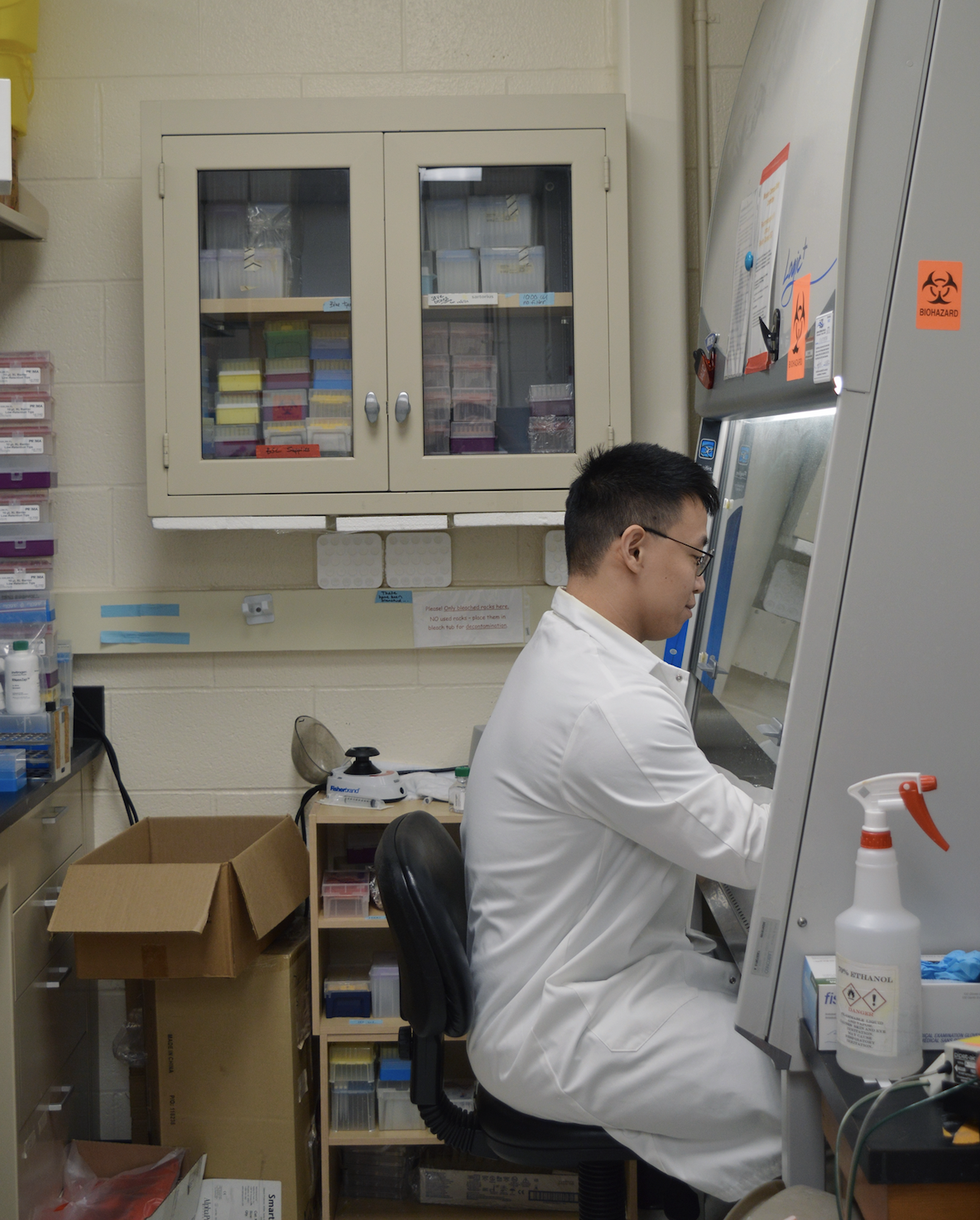
Ohio State PhD student Mingde Liu, who engineered the vaccine candidate.

“Our idea is to have a live attenuated vaccine to replace the feedback material, to mimic natural mucosal infection but not cause disease,” Wang said. 

A key advantage of the technology is the viral backbone Wang built as the foundation of the vaccine. 

“If new variants emerge in the future, I can quickly replace the S protein with the new circulating strain to update the vaccine,” she said. “This backbone also has space to incorporate antigens from other enteric viruses, such as rotavirus, so it creates many possibilities for future vaccines.” 

Veterinarian James Mark Hammer, president of Innovative Viral Solutions, is leading commercialization of the technology. 

“Doctor Wang built a controllable version of this virus and removed the pieces that make it dangerous,” Hammer said. “My role is to take that science and move it through the commercialization and licensing process so it can reach the industry.” 

Hammer estimates PEDv outbreaks reduce pig production by roughly 10 to 12 percent, creating major financial strain for farms. 

“You can imagine trying to run a farm and losing 10% of your pigs,” Hammer said. “You still have all the costs of maintaining those sows, but you lose a month of income.” 

James Mark Hammer, president of Innovative Viral Solutions,

Innovative Viral Solutions has licensed the technology from Ohio State and plans to pursue regulatory approval through the U.S. Department of Agriculture’s Center for Veterinary Biologics. The company is currently raising approximately $2 million to support early purity and potency studies required for an experimental vaccine license. In addition to internal funding from Ohio State, Wang’s research received support from foundational grants from the U.S. Department of Agriculture’s National Institute of Food and Agriculture (NIFA).

Wang will continue to serve as a scientific consultant as development moves forward. 

“This is a meaningful example of how Ohio State innovations are translated into solutions that address animal health and urgent needs of our farming community ," said Kevin Taylor, chief innovation officer at Ohio State.  “By combining Dr. Wang’s scientific leadership with a clear commercialization pathway, this technology has the potential to improve animal health, strengthen food production systems and create meaningful economic impact.”