Research Impact at Ohio State
Highlighting discovery, innovation and collaboration

Ohio State students showcase biomedical breakthroughs at the Ohio Statehouse

Ohio State students brought their biomedical research directly to state lawmakers this week, presenting projects that span cancer prevention, vision restoration, public health and more. 

“The 23 students presenting today have been in their research labs for at least two years,” said Steven Mousetes, program manager and instructor for biomedical science in the College of Medicine. “One of the things we work on is how to present their research to a lay audience, so people can understand the value of their research and why it’s important.” 

The event provides students in the biomedical science major an opportunity to translate complex science into accessible conversations beyond the laboratory. For Elina Parekh, a junior from Mason, Ohio, that conversation is rooted in family. 

Parekh studies mechanisms of retinal regeneration, focusing on molecular pathways that could one day reverse vision loss caused by diabetic retinopathy and age-related macular degeneration. Current treatments can slow progression. They cannot restore sight. 

“My cousin has diabetic retinopathy, and she’s been 100 percent blind since she was around 20,” Parekh said. “Seeing how her disease progressed over time really impacted me. I want to be able to help other people.” 
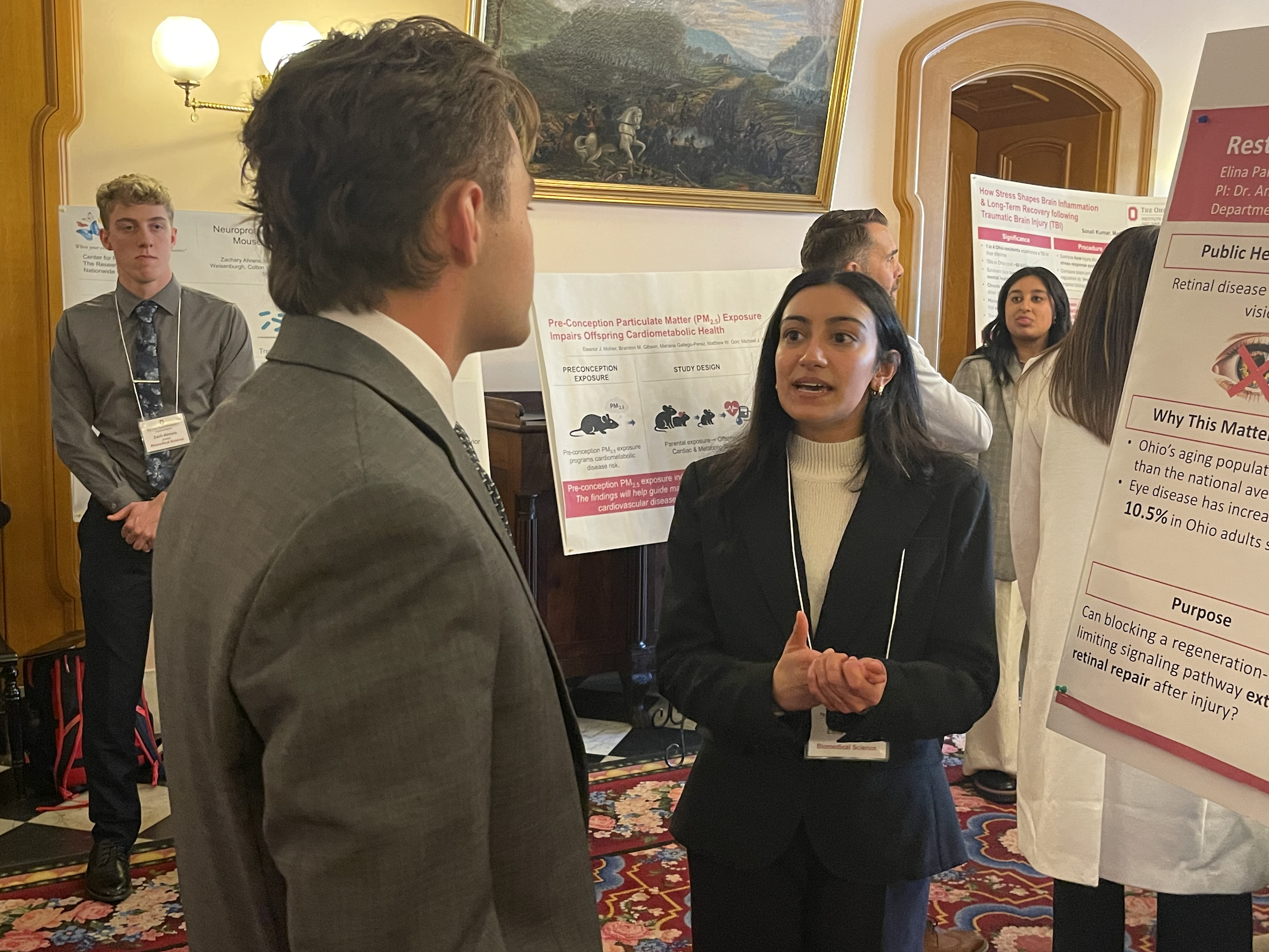
Elina Parekh, a junior from Mason, Ohio, presents her research during the event.
Elina Parekh, a junior from Mason, Ohio, presents her research.

She began research as a first-year student and said it transformed how she approaches unanswered questions. 

“In research, we’re trying to answer questions that really don’t have an answer,” Parekh said. “It just really changes the way that you think about the world and how you see things.” 

Along the way, she found mentorship from her principal investigator and older students in her lab. Now, she mentors younger researchers herself. 

“As time progressed, I’ve become that kind of mentor to the younger students in my lab,” Parekh said. “So, it’s kind of a full-circle moment.” 

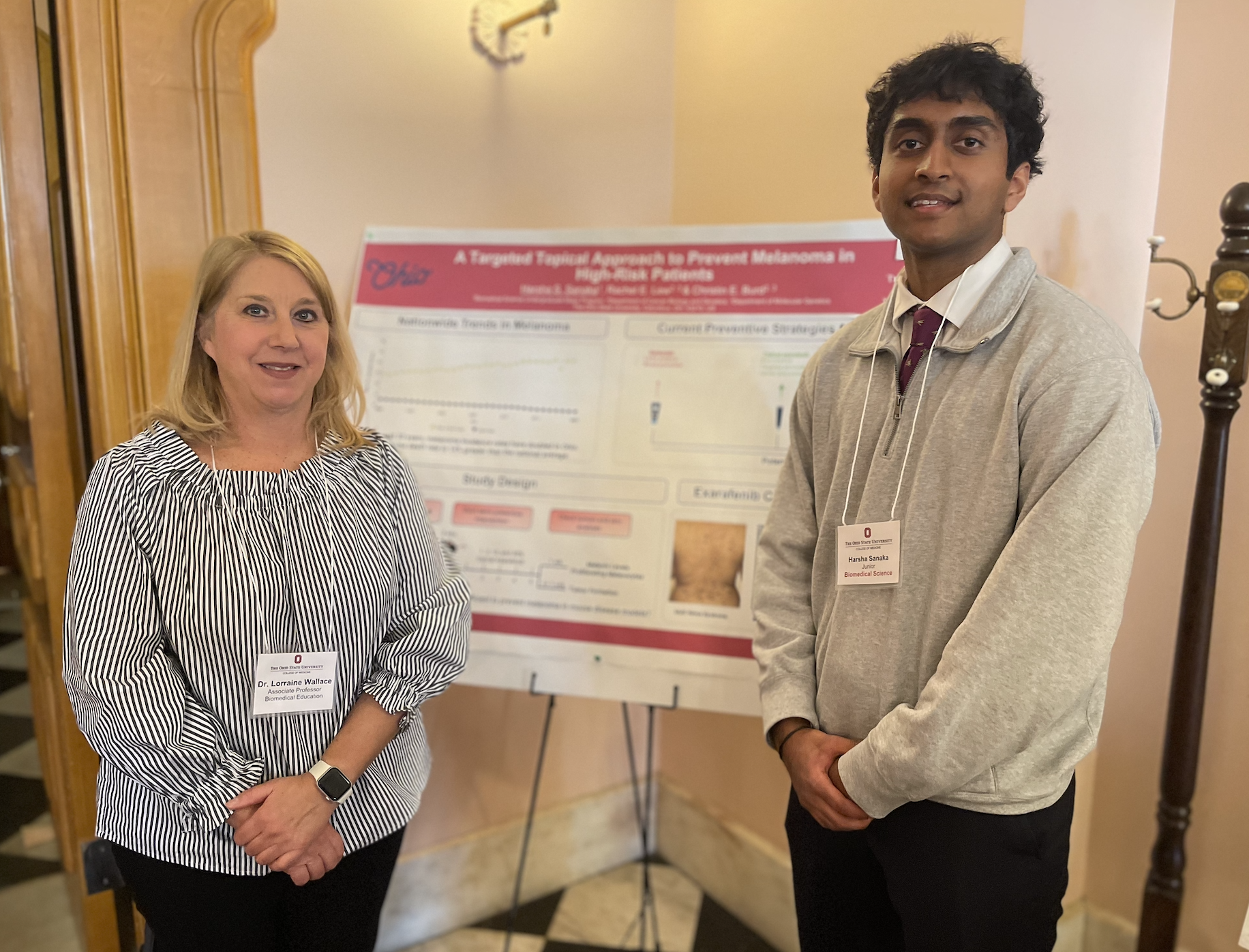
Harsha Sanaka, a junior from the Cleveland area, presented research focused on melanoma prevention. Melanoma is the deadliest form of skin cancer. Preventive options are limited to sunscreen, which cannot undo prior sun damage, or surgical excision in high-risk patients. 

Sanaka’s project explores whether a drug currently being tested in clinical trials for metastatic melanoma could instead be used preventively as a topical therapy to eliminate cancerous precursors before cancer develops. 

“What we’re proposing is using a drug that’s currently being tested in clinical trials as treatment for metastatic melanoma,” Sanaka said. “Instead of using it as an intervention, we’re trying to use it as a preventative therapy.” 


For him, presenting to lawmakers reinforced the connection between scientific discovery and public service. 

Harsha Sanaka, a junior, with Dr. Lorraine Wallace, associate professor in the Department of Biomedical Education in the College of Medicine.

“Ultimately, this research is driven by public support,” Sanaka said. “It’s really important for everyone to understand what the research is doing, what its purpose is and what’s taking place behind the scenes.” 

Many of the projects were intentionally tied to issues affecting Ohio communities, from aging populations to chronic disease. 

“If you look at most of their visual abstracts, they’re tied to issues affecting communities across the state,” said Dr. Lorraine Wallace, associate professor in the Department of Biomedical Education in the College of Medicine. “We’ve worked to ensure their research speaks to the challenges lawmakers are addressing so they’re familiar with the work Ohio State students are conducting.” 

The biomedical science major is built around early immersion in research, with students spending much of their junior year focused on laboratory projects. A high percentage of graduates go on to medical school, while others pursue careers in allied health fields such as physician assistant studies, physical therapy or public health. 

The program emphasizes both scientific rigor and the ability to communicate complex ideas clearly, particularly as many students pursue careers in medicine and translational research. 

“You’ll see the culmination of some of their research projects today in poster form,” said Dr. John Gunn, faculty director for the biomedical science undergraduate major at Ohio State. “And their exceptional ability to talk about their research and how far they’ve matured in their scientific abilities to communicate.”