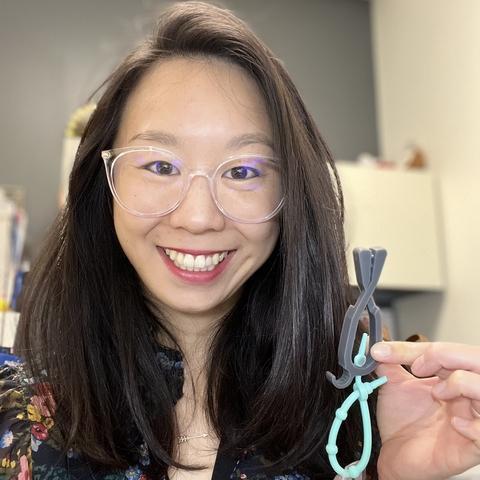
One case study follows the development of a high-fidelity nasal bridle training model Meade created with undergraduate biomedical engineering students.
A nasal bridle secures a nasogastric, or NG tube, which drains or decompresses the stomach for patients who have bowel complications from cancer or other abdominal abnormalities. If the tube shifts or is accidentally removed, it often must be reinserted, creating additional discomfort for the patient.
While training clinicians, Meade realized existing training models did not adequately prepare learners to perform the procedure on patients.
“What we used before was not very translatable for the skill because I saw people struggling and patients suffering from it,” she said. “I was like, ‘We can do better.’”
Working alongside engineering students and other faculty from the College of Nursing and the Division of Anatomy from the College of Medicine, Meade helped develop a more realistic training model that better replicates patient anatomy and the procedure itself. The high-fidelity training model gives clinicians an opportunity to build confidence in a safe environment before performing the technique on patients.
“This trainer device helps learners transfer skills from a safe environment to the real person,” Meade said.
The publication’s second case study focuses on the b3 Buddy, or Bag Below Bladder Buddy, a device designed to standardize how urinary drainage bags are secured.
Urinary drainage systems depend on gravity. If a drainage bag is positioned above the bladder, urine can flow backward, increasing the risk of infection. The b3 Buddy keeps the collection bag below the bladder, reducing that risk while creating a more consistent approach to urinary drainage bag management. Originally designed for patients who are walking, the team is expanding its use to patients in beds and chairs, where proper bag placement can be just as challenging.
“The benefit of having a standardized way to secure urinary drainage bags is that when we are able to secure the bag below the bladder, there’s a decreased risk of infection because anything that comes out of the bladder should stay out and not go back in,” Meade said.
The publication also traces the b3 Buddy’s path from concept to commercialization.
With guidance from Hamid Bhatti, senior licensing officer with Ohio State’s Innovation and Commercialization team, Meade and her collaborators participated in the U.S. National Science Foundation I-Corps Regional program in 2024 before receiving a $50,000 Accelerator Award, funded by Ohio State and the Ohio Third Frontier, to advance the technology. The funding supported a freedom to operate analysis, helped define the device’s regulatory pathway and allowed the team to develop an alpha prototype. The project later entered the I-Corps Boost Program, where the team continued customer discovery and refined how the technology could fit into the health care marketplace.
“Karen’s work demonstrates what is possible when clinicians, engineers and commercialization experts work together to solve everyday health care challenges,” said Sanjay Krishna, senior associate vice president for Innovation and Strategic Ventures within the Enterprise for Research, Innovation and Knowledge. “Her publication illustrates how collaboration across disciplines can transform ideas inspired by patient care into innovations with the potential to improve lives well beyond Ohio State.”
For Meade, both projects underscore the value of bringing together people with different expertise. Nurses understand the challenges clinicians and patients face every day. Engineers contribute the technicalexpertise to design solutions. Commercialization experts help move promising ideas beyond the prototype stage and toward broader adoption.
Success, she said, depends on something even more fundamental.
“Many of our vocabulary in medical terms is not accessible to others,” Meade said. “Engineers cannot speak the same language they speak to each other when they speak to us because we don’t understand their terminology either. We really need to find common ground in communication.”