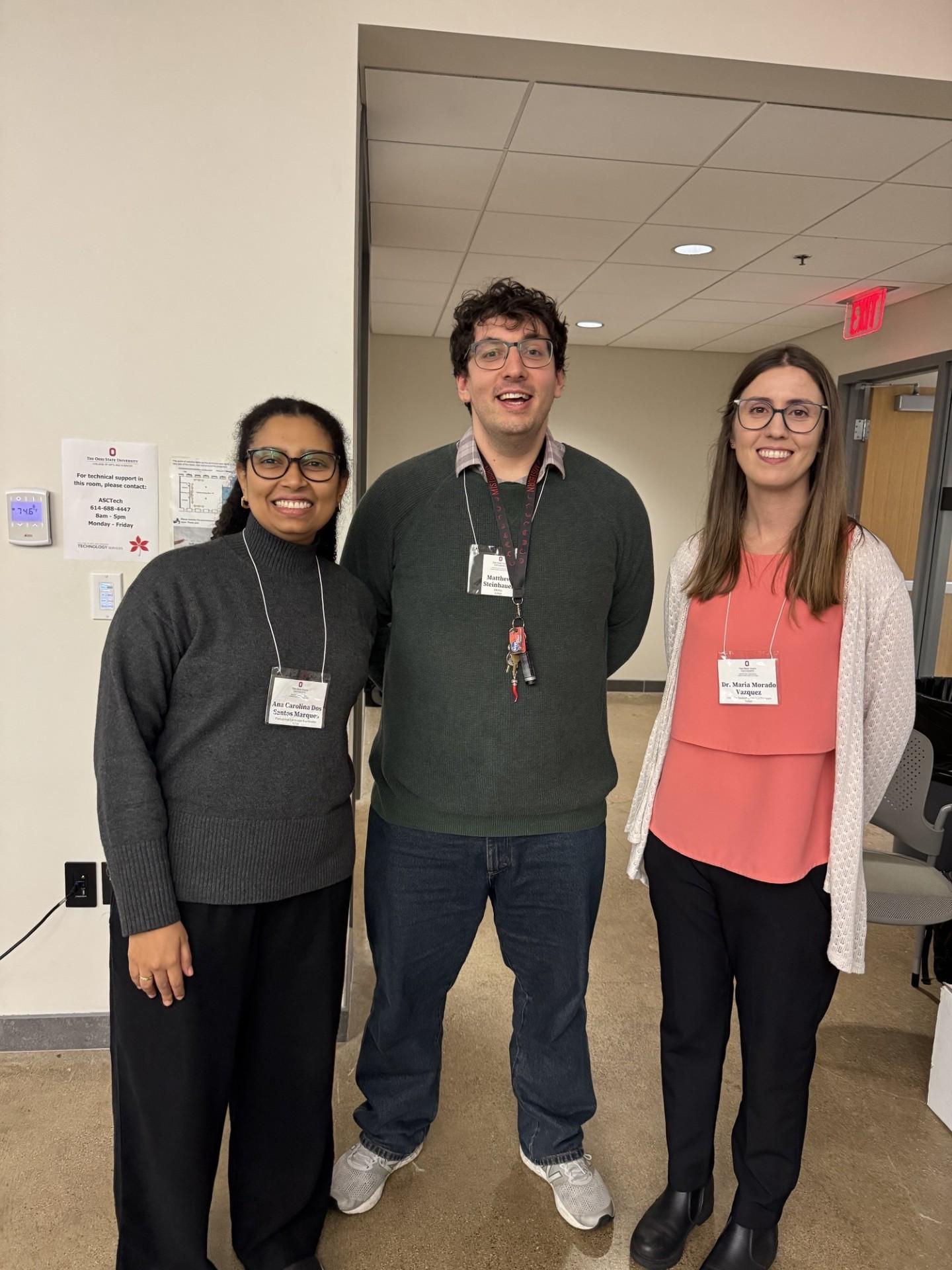
Vosmosis grew directly out of Steinhauer’s doctoral research and reflects a new kind of innovation emerging from Ohio State, one that bridges humanities scholarship, pedagogy and advanced technology.
From the university’s perspective, Vosmosis exemplifies how student driven research can move beyond the classroom and into real world impact.
“This is exactly what innovation at Ohio State looks like,” said Kevin Taylor, chief innovation officer at Ohio State. “Matthew took a question that emerged from his PhD research and turned it into a solution with the potential to change how people learn. It shows how Ohio State empowers graduate students to translate discovery into impact.”
The project is also noteworthy for where it originated, said Dana Renga, divisional dean of Arts and Humanities at Ohio State.
“One of the most exciting things about this technology is that it is one of the first times in Ohio State’s history that someone from the humanities, and specifically a graduate student in world languages, has been involved in this type of entrepreneurial endeavor,” Renga said. “Typically, when people think about commercialization and startups, they think about STEM fields. What Matthew has done challenges that assumption.”
Renga added that Steinhauer’s deep commitment to cultural understanding is central to Vosmosis’ success.
“He’s incredibly committed to understanding cultures not as a tourist, but as a learner and communicator,” Renga said. “That perspective really shapes what this technology is trying to do.”
Steinhauer came to Ohio State with an interest in using virtual reality to support students who do not have the resources or flexibility to study abroad. While pursuing his PhD in East Asian languages and literature, he became increasingly focused on how cultural knowledge is embodied.
He sees language learning as inseparable from cultural participation.
“It is actually quite difficult for Western learners to become proficient in East Asian languages,” Steinhauer said. “Not because the languages are impossible, but because the cultures are different. You need time in those societies to understand how people use their bodies to convey meaning and how social interactions work.”
Traditional classroom instruction often emphasizes grammar and vocabulary, but students may still struggle to communicate effectively. Vosmosis addresses that gap by giving students a space designed to look and feel as if in the target language culture to practice communication itself.
Renga views the project as part of Ohio State’s broader commitment to world languages and the humanities at a time when many institutions are moving in the opposite direction.
“Across the country, world language programs are under real pressure,” Renga said. “Ohio State is doing the opposite. We are investing in languages. We offer 31 languages and have eight world language centers. That is incredibly rare.”
Vosmosis also aligns with Ohio State’s approach to thoughtfully integrating emerging technologies such as artificial intelligence and virtual reality into teaching and learning. Steinhauer expects the technology to be a go to tool for teachers who can have a handful of students use the virtual environments during class and increase collaboration with the remaining students. Students will be excited because they enjoy multiple types of engagement during class time.
“Some people worry that AI or VR will replace language learning,” Renga said. “This does the opposite. It deepens engagement. Students still learn the language. They still study grammar and vocabulary. But now they are also experiencing culture.”
Access and affordability remain central to Steinhauer’s vision. Vosmosis is designed to provide transformative cultural experiences to students who cannot immediately travel abroad, while also motivating them to pursue international opportunities in the future.
Renga sees that potential firsthand.
“Once students have this kind of immersive experience, it makes studying abroad feel possible,” Renga said. “It shows them what they could be working toward.”
Vosmosis has recently completed the licensing agreement from Ohio State and is currently in the process of identifying a Japanese textbook that aligns with Steinhauer’s theory and approach, which will then be extended with immersive virtual experiences. Once those modules are developed, the team plans to pilot the platform at Ohio State through the Department of East Asian Languages and Literatures.
Steinhauer and collaborators are also partnering with Brigham Young University to test the model with additional student populations. They are also working with Rev1 as part of the state of Ohio’s technology startup support network to finetune their business strategy and begin raising investment funds.
Because existing speech recognition systems are not trained on beginner language learners, early versions of Vosmosis rely on human guidance behind the scenes. Steinhauer hopes to eventually build specialized datasets that will allow greater automation and advance research at the intersection of language learning and artificial intelligence.
For Steinhauer, the work represents both a scholarly pursuit and a personal mission.
“I want a future where students are not told, ‘This language is too hard for you,’” he said. “Instead we can say, ‘We have another way.’”