Research Impact at Ohio State
Highlighting discovery, innovation and collaboration

Ohio State researchers develop process that turns carbon dioxide and industrial waste into hydrogen

Study demonstrates a new approach to carbon capture while producing a commercially useful mineral

Researchers at The Ohio State University have developed an electrochemical process that converts carbon dioxide and industrial waste into hydrogen while permanently storing carbon in the form of calcite, a mineral used in a wide range of manufacturing applications. 

The research, led by scientists in the College of Arts and Sciences and published in ACS Energy Letters, captures the energy naturally released when carbon dioxide reacts with minerals and redirects it to reduce the electricity required for hydrogen production. Rather than treating carbon mineralization and hydrogen production as separate processes, the system links the two by using the energy released during mineralization to help power water electrolysis. 

“Instead of consuming energy to capture carbon dioxide, we found a way to harvest the energy released during carbon mineralization and use it to help produce green hydrogen,” said L. Robert Baker, Andrei Baronov and Ratmir Timashev Professor in Chemical Physics in the Department of Chemistry and Biochemistry and senior author of the study. 

Hydrogen is widely viewed as a promising clean energy source because it produces no carbon dioxide when used as a fuel. Conventional hydrogen production through water electrolysis, however, requires significant amounts of electricity. The Ohio State team’s process uses the chemistry of carbon mineralization to create a pH gradient that lowers the energy needed to split water into hydrogen and oxygen. 
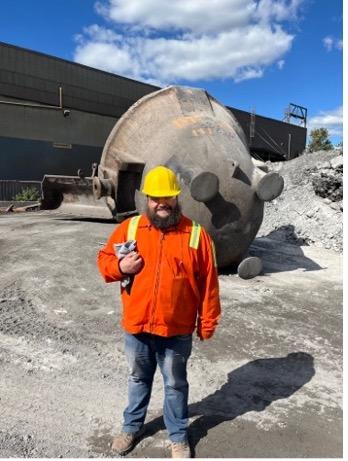
Dr. Tomaz Neves-Garcia

The researchers found the process captured more carbon dioxide per kilowatt-hour than the emissions associated with the grid electricity used to power it, enabling net-negative carbon hydrogen production under those operating conditions. 

Rather than storing captured carbon dioxide underground, the process converts it into high-purity calcite, a form of calcium carbonate used in products including cement, concrete, paper, plastics, pharmaceuticals and agriculture. 

The technology also uses industrial byproducts, including steel slag and coal ash, as feedstocks for carbon capture. 

“We demonstrated the process using real steel slag, illustrating a pathway for simultaneously reducing industrial waste while permanently storing carbon dioxide,” Baker said. 

The process integrates carbon capture, hydrogen production, and industrial waste reuse in a single electrochemical system, producing hydrogen and calcite from materials that would otherwise be discarded. 

“This technology is exciting because it takes two abundant waste streams and converts them to valuable products, which are in high demand for fuel and manufacturing. Even better, it does this at record efficiency by harnessing the energy released by mineralization of CO2,” Baker said. 

While additional research is needed to evaluate the technology at larger scales, the findings demonstrate a new approach to coupling carbon capture with clean energy production. 

“Our technology does not treat CO₂ as a burden that must be managed, but as a resource that creates value. Climate solutions do not have to be more expensive, they can be simpler, scalable, and economically attractive,” said Tomaz Neves-Garcia, postdoctoral scholar in the Department of Chemistry and Biochemistry and lead author of the study. 

The study also included Corrado Masciocchi, an Ohio State Research Experiences for Undergraduates fellow.